
Rungard
The constraint on an agent workforce is not how many agents you can run. It is how much output a human can trust without reading it.
Email to get notified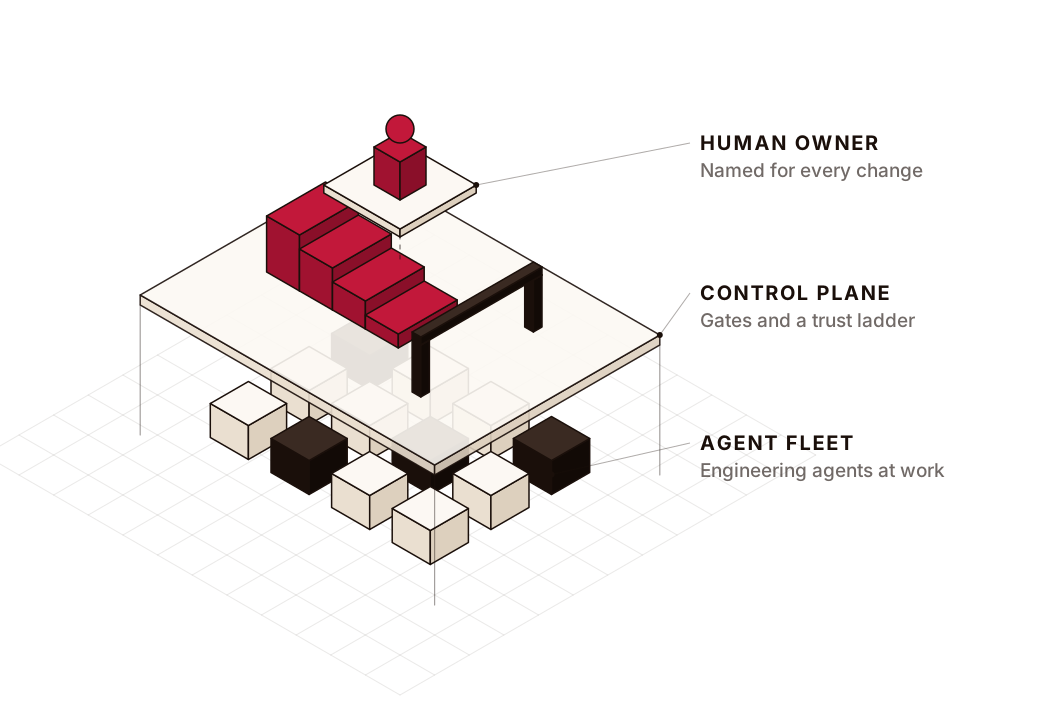
More agents, same number of reviewers.
Starting ten coding agents is easy. Reading what ten agents produced is not, and a team that cannot review the output either slows down or stops looking.
Rungard is for teams that run agents across several projects and need to know which kinds of work can go through unread, and which cannot.
What it does
A trust ladder, not a global switch
Autonomy is granted per type of task and per project, from measured review outcomes.
Review as a scarce resource
Human attention is routed to the work that needs it and calibrated against results.
Deterministic gates
Checks that do not depend on a model decide whether work can move forward.
A named owner for every change
Each change is tied to the person who answers for it.
Separate tenants from the start
Each customer's data is isolated, and operator access is audited.
Cost per accepted unit
The measure is what an accepted piece of work cost, not how many tokens were spent.
- Task
- Agent run
- Gates
- Review, by trust level
- Accepted
Where it stands
- The specification is written, and the main architecture decisions are approved.
- The hosting infrastructure is provisioned.
- The product itself is being built and cannot be used yet.
- There are no dates. Leave your email and we will write when there is something to try.

How it's built
Rungard is developed with the kit, and it is the kit's ideas taken to the scale of a fleet.
- Python
- PostgreSQL
- React
- Docker
- OpenTofu