
Essay · Georgian Dinca
The Blacksmith's First Tongs
There's an old saying in the trades: the blacksmith is the only craftsman who can make his own tools.
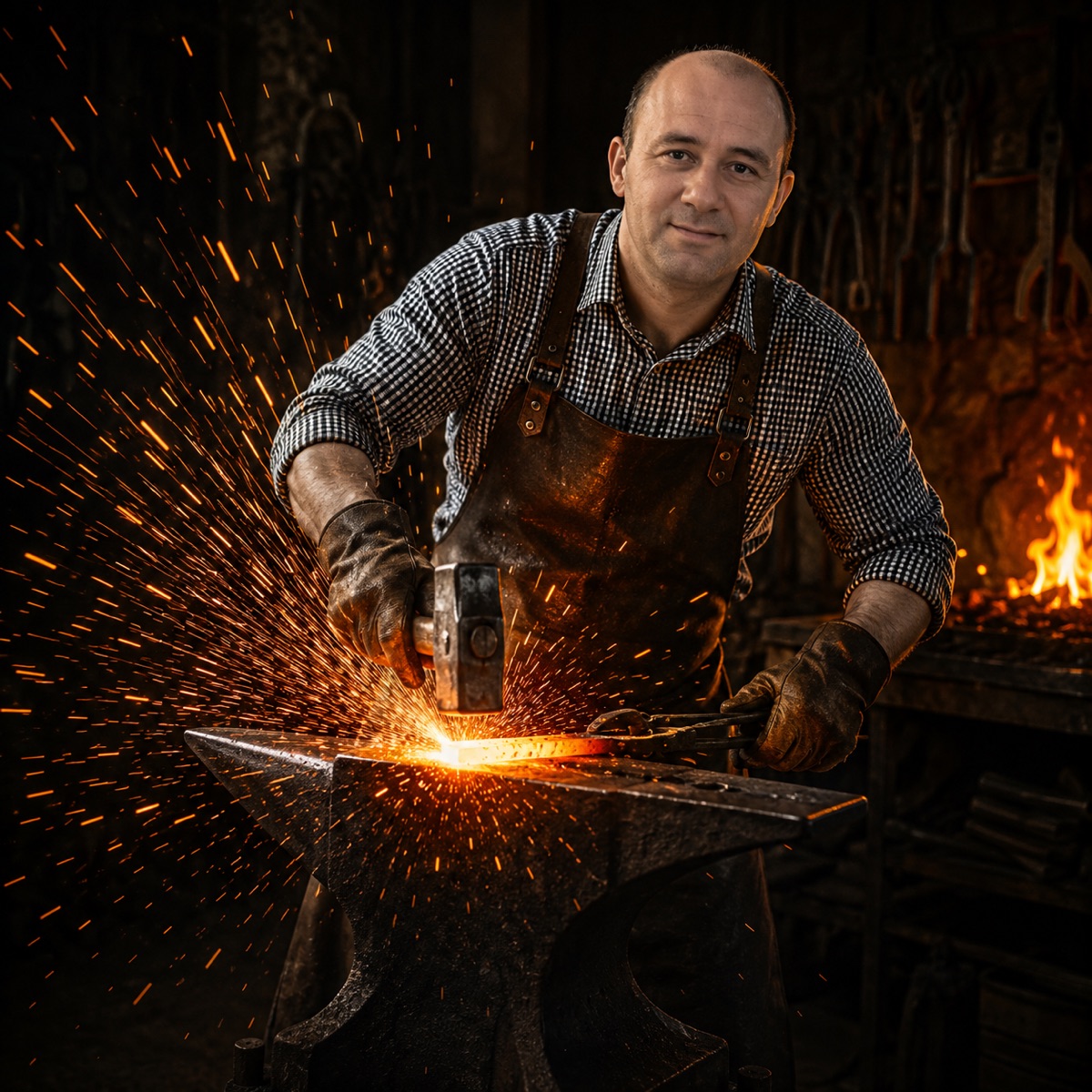
Think about it for a moment. A carpenter cannot saw a saw into existence. A tailor cannot sew a needle. But a blacksmith, standing at the anvil, can forge a hammer — using another hammer. For centuries, this wasn't a curiosity; it was the job. Walk into any smithy and you'd find a wall of tongs, dozens of them, each one shaped for gripping a specific size and shape of stock. Almost none of them were bought. The smith made them, one by one, as the work demanded.
And here's the part I find most telling: forging your own tongs was traditionally one of an apprentice's first real tests. Not because the master was too cheap to hand over a pair, but because making the tool was the training. You couldn't understand hot metal until you'd shaped it into something you would then depend on every day.
Of course, even the smith didn't start from nothing. The anvil and that first hammer were bought, inherited, or traded for. Nobody forges their own anvil. You acquire the foundation — and then you build everything else on top of it.
I've been leading engineering teams through the AI transition for a while now, and I keep coming back to this image.
We are all back in the smithy
Software development in the AI era has quietly become a tool-making craft again. The foundation models are our anvils — enormously capable, and not something any of us forges ourselves. We acquire them. But everything that makes them genuinely useful on real delivery work, we build: the prompts, the skills, the agents, the integrations, the guardrails.
And just like the smith's wall of tongs, the tools that matter are rarely the general-purpose ones. On my team, the pieces that actually moved the needle were narrow and purpose-shaped: an assistant tuned for a specific kind of platform upgrade, an auditing tool for third-party extensions, a scaffolding accelerator for one particular type of application. Each one is a pair of tongs — useless for almost everything, perfect for one grip. When a new shape of work shows up, we don't go shopping. It's usually faster to forge the tool on the spot, exactly the way a smith would knock together a one-off jig for an odd job.
The apprentice's lesson
Here's the point I'd underline twice, especially for engineers early in this transition.
There's a real difference between using AI tools and making them. Consuming someone else's prompts and agents makes you an operator. Forging your own makes you a smith. The act of building the tool — deciding what it should grip, testing it against real metal, filing down the edges when it slips — is where the actual understanding comes from. You cannot learn how these systems behave, where they're reliable, and where they quietly fail by reading about it. You learn it the way the apprentice learned: by making your first pair of tongs, watching them fail, and making a better pair.
If you lead a team, this has a practical consequence: tool-making shouldn't be a side activity reserved for the enthusiasts. It's the curriculum.
Consuming someone else's prompts and agents makes you an operator. Forging your own makes you a smith.
An honest caveat
Every metaphor breaks somewhere, and this one breaks in an important place. The blacksmith's hammer never improved on its own between projects, and it certainly never surprised him. Our tools do both. The anvil we bought last year is not the anvil we have today — it got better underneath us — and the tools we forge on top of it behave with a degree of unpredictability no piece of forged steel ever did. That demands something the old smithy never needed: continuous re-testing of our own tools, judgment about when to trust them, and the humility to keep a human hand on the work that matters.
What happened to the blacksmiths
One last thing from history, because I think it's the most useful part.
Blacksmiths did not disappear when industrial forging arrived. The craft split. Mass production absorbed the repetitive work — the nails, the horseshoes, the standard fittings. The smiths who remained moved up: custom work, high-judgment work, restoration, art. And a great many of them became toolmakers and machinists — quite literally the people who built and maintained the machines that had changed their trade.
That, I think, is the honest story for software engineers right now. Not replacement. A split — with the interesting side of the split belonging to the people who learned to build the machines rather than merely watch them run.
The question isn't whether the machine replaces the smith.
It's whether you're forging your own tongs.