
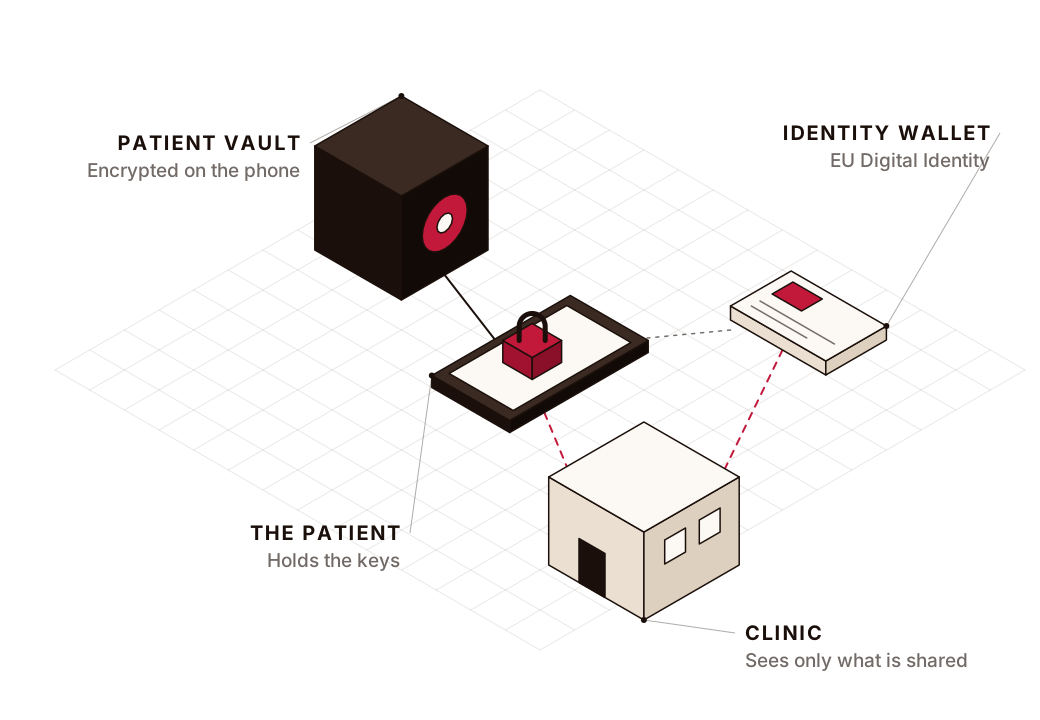
Your medical history is scattered, and you prove who you are by filling in forms.
Test results, scans and discharge letters sit in different clinics, on paper and in email. Showing them to a new doctor means carrying a folder.
At the reception desk the same patient types their name, date of birth and insurance details again, and the clinic types them into its own system.
We are working on both ends: a vault the patient owns, and a way to check in with a digital identity wallet.
Patient vault
A mobile app where a patient keeps their medical records, encrypted on their own device before anything is uploaded. The server never sees the content.
Encrypted on your device
Records are encrypted before they leave the phone, with keys only the patient holds.
Share links for doctors
A doctor opens a link in a browser, with no account. Links expire, have a view limit and can be revoked.
A tamper-evident trail
Every access is recorded in a log that shows if it has been altered.
Family vault
One person can keep records for children and parents.
Recovery without us
Recovery codes and biometric unlock, so access does not depend on a support desk.
Standard export
Records can be exported in the FHIR R4 format used by health systems.
Where it stands
- The server, the mobile app and the doctor's viewer exist and work together.
- The app is not yet available in the app stores.
- Sign-in with an eIDAS electronic identity is planned.
EUDI health verifier
A service for clinics that accepts identity and health-cover credentials from an EU Digital Identity Wallet, so a patient checks in by scanning a code.
Verified data, no typing
Name, date of birth and cover arrive verified from the wallet instead of being typed at the desk.
Only what is needed
The clinic asks for specific attributes per use case, and the patient sees and approves exactly those.
Built on the public standards
OpenID4VP for presentation, with SD-JWT VC and mdoc credentials, as defined for the European wallet.
Straight into the clinic system
The verified result is delivered as FHIR Patient and Coverage records.
A record of every request
An audit log shows what was asked, for which purpose and with what result, without storing the patient's identity in clear.
- Patient's wallet
- Verifier
- Reception console
- Clinic system
Where it stands
- A functional specification is written. Nothing is built yet.
- The test bed is the EU reference wallet, with test identities only.
- The health credentials are our own draft schemas until official issuers publish theirs.
How it's built
The vault is developed with AI agents.
- Go
- PostgreSQL
- React Native
- Next.js
- FHIR R4
- OpenID4VP