
AI-SDLC Bootstrap Kit
One brief, every tool. Rules as code. Ground, don't guess. Human owns the loop.
View on GitHub ↗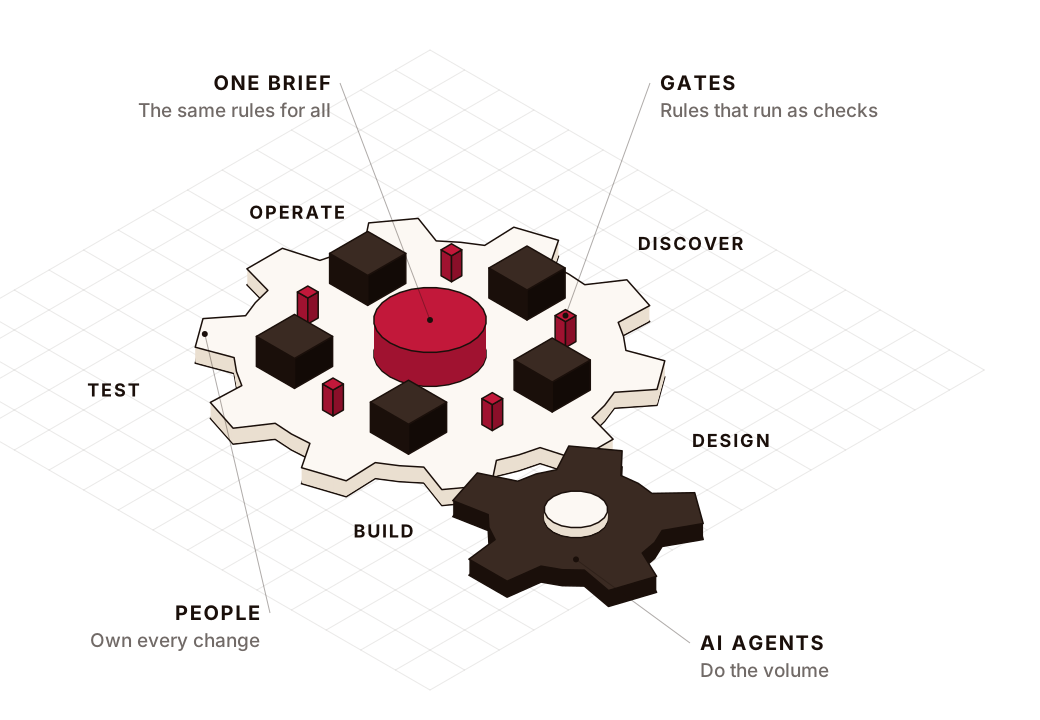
Add it as a plugin. The agent does the install.
The kit ships as a plugin for Claude Code, Codex and Antigravity. Add it, then start the agent with the setup as its first instruction: it checks your project, proposes where the kit should sit, and writes nothing until you agree.
The lines after the last command summarise what the skill does first.
AI agents write code. Who answers for it?
Teams adopt AI agents one developer at a time. Each tool gets its own instructions, nobody can say which changes an agent made, and the rules live in people's heads.
The kit is for any software team that wants agents working inside the same rules as people: grounded in the project's own knowledge, attributable to a named person, and stopped by CI when a rule is broken.
What it puts in your repository
One canonical brief
A single AGENTS.md that every AI tool reads, so instructions are written once and do not drift.
Five role seats
Architect, Engineering Manager, Product, Developer and QA, each with its own playbook and scoped connectors.
Rules as code
Governance checks run as pre-commit hooks and CI merge gates, so a rule is enforced and not merely written down.
A local knowledge graph
Docs and code are indexed so an agent answers from the project's sources, with a citation, and says so when it cannot.
Git verbs for everyone
People who do not use git can save their work, get the latest and send for review in plain words.
A usage dashboard
Utilization, commit attribution as human, AI or mixed, waste signals and cost. The point is honest cost and quality, not surveillance.
Where it stands
- Version 0.1.0, MIT licence, public on GitHub.
- Built and tested: the bootstrap script with four layouts and a non-destructive merge, the Claude Code plugin installer, the validators, and the knowledge graph with its viewer.
- Still in draft: the designs for the issue ledger, token return on investment, and the team session ledger.
- This website is built with it.

How it's built
Plain shell and Python, so it runs anywhere a repository does and adds no service to operate.
- Bash
- Python
- SQLite
- Streamlit
- GitHub Actions
- pre-commit
- MCP